~A Boy Always Young~

2015年4月9日 星期四

高血脂健保給付


全民健康保險降三酸甘油酯藥物給付規定
CAD or DM: TG≧200 且 TC/HDL-C>5 或 HDL-C<40
No CAD nor DM: 3-6 個月非藥物治療


全民健康保險降膽固醇藥物給付規定
CAD or DM: TC>160 or LSLS>100
危險因子:
1.高血壓
2. 男性≧45 歲,女性≧55 歲或停經者
3. 有早發性冠心病家族史(男性≦55 歲,女性≦65 歲)
4. HDL-C<40mg/dL
5. 吸菸(因吸菸而符合起步治療準則之個案,若未戒菸而要求藥物治療,應以自費治療)。

2 factors: TC>200 or LDL >130
1 factor: TC>240 or LDL > 160
0 factor: LDL > 190
read more

2015年3月10日 星期二

Charcot’s Neuroarthropathy


Charcot’s neuroarthropathy affects the joints and bones of the feet. The development of this condition include severe peripheral neuropathy and autonomic dysfunction with increased blood flow to the foot; the peripheral circulation is usually intact.

The actual pathogenesis is poorly understood; however, the patient is vulnerable to trauma that may not recall. Repetitive trauma results in increased blood flow through the bone, increased osteoclastic activity, and remodeling of bone. In certain cases, patients walk on a fracture, which leads to continuing destruction of bones and joints in that area. Acute Charcot’s neuropathy may be triggered by any event that leads to localized inflammation. This may trigger a vicious cycle in which there is increasing inflammation, increasing expression of RANKL (a member of the tumor necrosis factor superfamily), and increasing bone breakdown.

Charcot’s neuropathy is sometimes difficult to distinguish from osteomyelitis or an inflammatory arthropathy. A unilateral swollen, hot foot in a patient with neuropathy must be considered to be a Charcot foot.

Charcot’s arthropathy can be diagnosed in most patients by plain radiography and a high index of suspicion. Radiographs may reveal bone and joint destruction, fragmentation, and remodeling. In such cases, the three-phase bisphosphonate bone scan shows increased bone uptake, although the 111In-labeled bone scan will be negative in the absence of infection.

Management of the acute phase involves immobilization. Evidence suggests that treatment with bisphosphonates, which reduce osteoclastic activity, may reduce swelling, discomfort, and bone turnover markers. Although Charcot’s neuroarthropathy is rare, it should be suspected in any patient with unexplained swelling and heat in a neuropathic foot.
read more

Glucose clamp technique


Glucose clamp technique is used to measure either how well an individual metabolizes glucose or how sensitive an individual is to insulin. Two types of clamps are quite commonly used.

The hyperglycemic clamp, which requires maintaining a high blood sugar level by perfusion or infusion with glucose, is a way to quantify how fast beta-cells respond to glucose.

The hyperinsulinemic clamp, which requires maintaining a high insulin level by perfusion or infusion with insulin, is a way to quantify how sensitive the tissue is to insulin.

Hyperglycemic clamp technique:
Glu raised to 125 mg/dl above basal levels by a continuous infusion of glucose. The glucose infusion rate is an index of insulin secretion and glucose metabolism. The hyperglycemic clamps are often used to assess insulin secretion capacity.

Hyperinsulinemic-euglycemic clamp technique:
The plasma insulin concentration is acutely raised and maintained at 100 μU/ml by a continuous infusion of insulin. The plasma glucose concentration is held constant at basal levels by a variable glucose infusion. When the steady-state is achieved, the glucose infusion rate equals glucose uptake by all the tissues in the body and is therefore a measure of tissue insulin sensitivity. The hyperinsulinemic clamps are often used to measure insulin resistance.
read more

Struma Ovarii


A teratoma of the ovary contains thyroid tissue that becomes hyperactive. Mild features of thyrotoxicosis result, such as weight loss and tachycardia, but there is no evidence of goiter or eye signs. Serum FT4 and T3 are mildly elevated, serum TSH is suppressed, and RAIU over the neck is low. Total body scan reveals uptake of radioiodine in the pelvis, rather than in the neck. The disease is curable by removal of the teratoma.
read more

2015年3月9日 星期一

MIBG scan


整理自長庚資料 (http://kelwww.cgmh-mi.com/examnm/i-131-mibg-scan)

MIBG(Metaiodo Benzylguanidine),是一種類似正腎上腺素的藥劑,會聚積在儲有catecholamine的腎上腺髓質嗜鉻性細胞或是交感神經末梢內,診斷嗜鉻性細胞瘤有76~100%的敏感度,在臨床上最常用於檢查的便是嗜鉻性細胞瘤。為預防I-131聚積而傷害甲狀腺,藥物注射前三天得開始服用 Lugol's solution(含碘試劑,用來阻斷解離的放射碘傷害正常甲狀腺組織)。MIBG因為結構類似 norepinephrine,必須緩慢注射以免引起高血壓的危險性。

適應症
嗜鉻性細胞瘤(pheochromocytoma)
甲狀腺髓質癌(medullary thyroid carcinoma)
亞神經節瘤(paragangliomas)
神經母細胞瘤(neuroblastoma)
類癌瘤(carcinoid tumor):位於小腸、闌尾、胃結腸發生之一種界線分明的黃色瘤。
read more

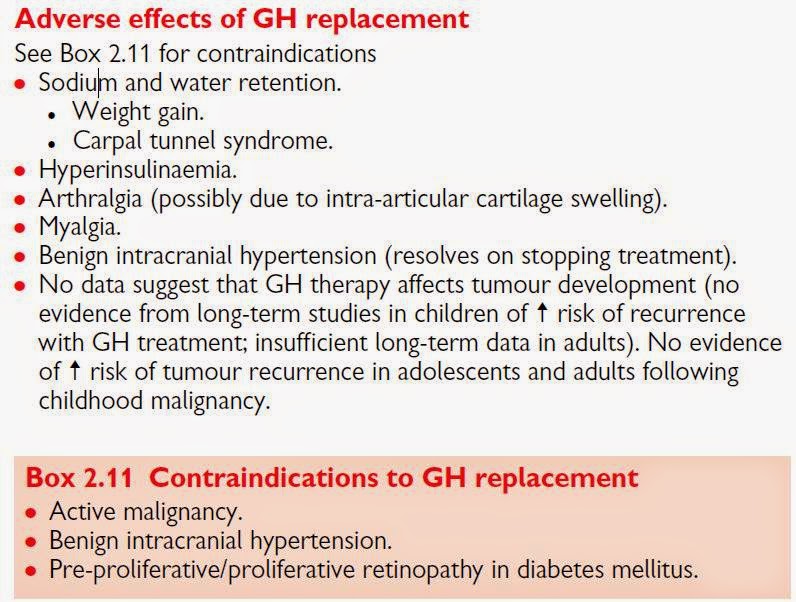
Adverse effects of GH replacement


read more

Pendred syndrome


Pendred syndrome is characterized by both goiter and sensorineural deafness (not caused by hypothyroidism). It is caused by a biallelic mutation in the SLC26A4 gene, located on chromosome 7 (7q31). Pendrin, a multifunctional anion exchanger, functions in both the thyroid gland and inner ear.

In the apical membrane of the thyroid gland, pendrin facilitates transport of iodide into the exocytic vesicles in which thyroid hormone is synthesized.

Pendrin is also expressed in the inner ear and is important for normal endolymph composition and maintenance of the endocochlear potential.
read more