~A Boy Always Young~

顯示具有 [醫學][內科]內分泌 標籤的文章。 顯示所有文章

2016年4月20日 星期三

ABI 適應症


糖尿病病人 >50歲, 一年可做一次篩檢 ;
糖尿病病人< 50歲, 合併一種CAD Risk factor, 一年routin 做一次篩檢
 ( CAD risk factor ; Hypertension or Hyperlipidemia or Smoking or 家族史)
read more

2015年11月17日 星期二

RAI治療


1 mCi = 1000 uCi

We typically administer 160 uCi/g thyroid tissue [5.9 MBq/g] for Graves' hyperthyroidism and 200 uCi/g [7.4 MBq/g] for toxic adenoma/MNG. A fixed dose of 10 to 15 mCi [370 to 555 MBq] for Graves and 15 to 20 mCi [500 to 740 MBq] for toxic adenoma/MNG is an alternative option.

For patients with significant symptoms of hyperthyroidism and in elderly patients with underlying cardiac disease, we suggest starting a methimazole to achieve euthyroidism prior to radioiodine therapy.

We discontinue methimazole three days prior to radioiodine and restart three days after radioiodine therapy.

For young and middle-aged patients who are less symptomatic, there is no need to pretreat with a thionamide, and radioiodine can be given soon after the diagnosis is made.
read more

2015年9月8日 星期二

Test for Cushing


## Low dose dexamethasone suppression test:
1. Dexamethasone 0.5mg 1# q6h since 9/11~9/12 (at 8AM, 2PM, 8PM, 2AM), total 2days=8 dose  
2. Collect 24 hours(9/12 08:00 ~ 9/14 08:00) Urine 17-OHC, cortisol x 2 days
3. check serum ACTH, cortisol on 9/13 8AM
異常:urine cortisol > 36mcg/day, serum cortisol > 1.4mcg/dL

## High dose dexamethasone suppression test:
1. Dexamethasone 0.5mg 4# q6h since 9/14~9/15(at 8AM, 2PM, 8PM, 2AM), total 8 dose (16mg)
2. Collect 24 hours(9/16 08:00 ~9/17 08:00) Urine 17-OHC, cortisol x 2 days
3. check serum ACTH, cortisol on 9/16 8AM
如果能夠把baseline的urine cortisol抑制90%以上-->猜cushing disease
read more

2015年8月7日 星期五

Three comdined pituitary function test


test for growth hormone deficiency
TRH test, LH-RH test, Insulin tolerance test

1. midnight NPO
2. On 20 號 medicut + 3 way, 接N/S(500ml) keep open (勿接IV lock)
3. Bed rest
4. 備血糖機及2amp 50% GW(for hypoglycemia with loss of conscious)
5. 8AM抽血
    ==> GH,  IGF-1,  TSH,  free T4,  LH,  FSH, PRL
           testosterone, E2,  ACTH, Cortisol,  plasma sugar
6. HRI        0.2 u/kg  iv push
    TRH       0.5 mg  iv push  30秒
    LH-RH   100 ug (0.1mg) iv push
7. 8點開始test後,第15' 30' 45' 60' 90' 120'分鐘時
   用血糖機測finger sugar
   同時要抽血測GH,  TSH,  LH,  FSH,  plasma sugar, Cortisol
8. check CBC/DC, Iron, TIBC, Ferritin, PLT, BUN,  Cr,  Na,  K
9. CXR
10. 請家屬幫忙準備含糖食物或飲料(果汁, 豆奶或糖果等)

1. TRH test==>注射TRH30'後,TSH應上升6以上,或大於2倍baseline值
2. LH-RH test==>LH在30' or 60'後上升4~6倍。FSH可能會上升一倍。
3. Insulin tolerance test==>GH在45'~60'後應至少上升7ng/mL(通常都10~20)。Cortisol通常會上升一倍。
read more

Test for primary aldosteronism


#  hypertension and hypokalemia are controlled
#  avoiding spironolactone and eplerenone

A. Oral sodium loading
<<Oral sodium loading test>>
1. 抽Aldosterone and Renin activity
2. 請病人每天吃鹽6 g,吃兩天
3. 第三天開始留24-hr尿,檢測urine aldosterone, Na/K, Cr.
4. Urine aldosterone excretion >12 to 14 mcg/24 hrs-->確診
5. Urinary excretion of sodium >200 mEq/day-->adequet sample

B. Intravenous sodium loading test (ABAYSALIN)
<<Saline infusion test>>
1. 請病人平躺
2. stat 抽Aldosterone and Renin activity before N/S hydration
3. N/S 2L run 4hr
4. 抽 Aldosterone and renin activity after N/S hydration
5. On EKG monitor, check BP and HR Q15 mins during test
6. If patient complained of SOB, chest discomfort, headache, etc...
    ==> please call Dr to see if the test should be stoped.
7. test 後PAC >10 ng/dL --> 確診,PAC <5 ng/dL --> 排除

C. Captopril challenge test
<<Captopril challenge test>>
1. 請病人至少維持坐立或站立一小時再開始test,直到結束
2. Captopril 25–50 mg PO
3. 服藥後1hr, 2hr各抽一次PRA, Aldosterone, Cortisol
4. Aldosterone >15ng/dl --> 確診

The use of the fludrocortisone suppression test is limited
The captopril suppression test is less standardized alternative if sodium loading is
contraindicated as in heart or renal failure.
read more

2015年8月6日 星期四

Hypercalacemia


ü  低鈣àPTH釋放àbone resorption, calcium reabsorption in the kidney, and increased production of activated vitamin D in the kidneyà升鈣
ü  PTH-mediated bone resorption is mediated by the RANKRANK ligand-OPG system.
ü  Hypercalcemia is an elevation of free, ionized calcium in the serum.
ü  Levels <12 mg/dL are asymptomatic; levels >15 mg/dL may cause severe symptoms. Rapidly progressing hypercalcemia is more likely to be symptomatic.
ü  The two most common causes of hypercalcemia: primary hyperparathyroidism and malignancy.
ü  原因:
²  increased bone resorption
Ø  PTH高: 80%是adenoma,還有hyperplasia, carcinoma, MEN
Ø  CKD: 因為鈣低、Vit-D缺乏à2nd hyperparathyroidismàtertiary
Ø  Malignancy:
u  PTHrP: primarily in squamous cell carcinomas, can also be seen in cancers of the kidney, ovary, and bladder. It is a frequent complication in lymphomas associated with HTLV-1.
u  Cancers with extensive skeletal metastases (multiple myeloma, breast cancer): release of cytokines (TGF-b, IL-1, IL-6, and macrophage inflammatory protein-1α) leads to osteoclast differentiation and inhibition of osteoblasts.
u  Ectopic: carcinomas of the lung, thymus, ovary, and undifferentiated neuroendocrine tumors
u  lymphoma and some ovarian dysgerminomas: increasing 1-hydroxylation of vitamin Dà higher 1,25-OH-vitamin D àincreased calcium absorption
Ø  Thyrotoxicosis: increased bone turnover
Ø  Excessive intake of vitamin A (>50,000 to 100,000 IU daily): IL-6增加
Ø  Prolonged immobilization
²  Vitamin D-dependent mechanisms
Ø  Chronic ingestion of more than 50,000 to 100,000 IU/day of ergocalciferol (vitamin D2) or cholecalciferol (vitamin D3)
Ø  Excessive or accidental ingestion of 1,25(OH)2D (calcitriol)àshould resolve within days.
Ø  Granulomatous: conversion of 25(OH)D to 1,25(OH)2D by macrophages
²  Milk–alkali syndrome: ingestion of milk or calcium carbonate, in the treatment of dyspepsia or osteoporosis. à associated with metabolic alkalosis and renal insufficiency
²  Other hormonal mechanisms
²  Drugs:
Ø  Thiazide: mild and transient (1 to 2 weeks)
Ø  Lithium: shifts the set point for calcium
Ø  Additional medications: estrogens, growth hormones, ganciclovir, omeprazole, 8-Cl-cAMP chemotherapy, manganese toxicity, foscarnet, hepatitis B vaccination, theophylline
²  Familial hypocalcuric hypercalcemia: 無症狀,heterozygous loss-of-function mutation in the calcium sensing receptoràincreased set point for calcium homeostasisàmildly elevated PTH, hypocalcuria, and hypermagnesemia
²  Miscellaneous other causes: adrenal insufficiency, pheochromocytoma, pancreas islet cell tumors, rhabdomyolysis恢復期, aluminum intoxication(diminished osteoblastic activity and reduced calcium incorporation into the skeleton)

ü  S/S: Neuropsychiatric symptoms, arrhythmia, constipation, polyuria and polydipsia, nephrolithiasis, Skeletal manifestations (osteoporosis or osteitis fibrosa cystica)
ü  先抽iPTH
²  高à驗尿鈣: 如果FeCa<1%猜FHH,>1%猜primary hyperpara

²  低à猜惡性、驗Vit-D: 如果1,25OH高猜lymphoma、granulomatous,如果25OH高猜Vit-D中毒。如果Vit-D正常猜雜七雜八的東西。
read more

2015年7月24日 星期五

SIADH


ü  ADHà 腎的V2à distal tubule and collecting ductàfree water retention and dilutional hyponatremiaà elevated urine osmolality in the setting of a low plasma osmolality

※ Essential diagnostic criteria:
ü  Plasma osmolality <275 mOsm/kg
ü  Urine osmolality >100 mOsm/kg and urine Na >20 to 40mEq/L
ü  Euvolemia
ü  Normal renal, adrenal, and thyroid function tests
ü  No recent use of diuretic agents

※ Euvolemic hypotonic hyponatremia:
ü  The most common cause of euvolemic hypotonic hyponatremia is SIADH.
ü  Characterized by low to normal total body sodium and normal to elevated total body water.
²  Hypothyroidismà dysregulation of ADH release or clearance, effects on vascular tone, cardiac output, and renal blood flow
²  Adrenal insufficiencyà caused by the loss of negative feedback on ADH secretion
²  Primary polydipsia
²  Potomania
²  Thiazide diuretics
²  Reset osmostat syndromeà shift in the set-point for ADH
²  Nephrogenic syndrome of inappropriate antidiuresisà mutations in the renal vasopressin V2 receptor causing increased water resorption,表現同SIADH但ADH測不到
ü  SIADH is usually self-limited, and the primary management strategy is to correct the underlying etiology.
ü  Loop diureticsà增加free water 排出、讓腎對ADH反應下降àenhance the effect of solute loading
ü  Demeclocycline acts on the renal collecting tubules to diminish responsiveness to ADH. The major side effect is nephrotoxicity.
ü  Vasopressin receptor antagonists exert their activity on renal V2 receptors resulting in a selective water diuresis without affecting sodium excretion

read more

2015年7月21日 星期二

Subclinical hyperthyroidism


原因:同甲亢
ü   Autoimmune thyroid disease
ü   Autonomous thyroid tissue
ü   TSH-mediated hyperthyroidism
ü   Human chorionic gonadotropin-mediated hyperthyroidism
ü   Thyroiditis
ü   Ectopic hyperthyroidism
會影響:
ü   The skeleton (bone resorption) and the cardiovascular system (increased risk of atrial fibrillation, heart failure, pulmonary hypertension, and angina) are the major target tissues adversely affected.
ü   Subclinical hyperthyroidism may also be associated with an increased risk of dementia.
評估:病史、用藥、PE
ü   Patients on suppressive levothyroxine therapyàTSH低是目標
ü   Patients on T4 for the treatment of hypothyroidismà不可以讓TSH太低
ü   女人要問有沒有懷孕,停經後或有骨鬆風險,可做骨密度檢查作為決定要不要治療的參考依據。
ü   沒吃T4的patients,persistently subnormal TSH values,如考慮藥治療,we obtain a radioactive iodine uptake and scan to help determine the etiology. 如有不只一處increased uptake, this could account for the low serum TSH. 如果沒有吸收,the etiology of subclinical hyperthyroidism may be thyroiditis or recent iodine exposure.
ü   Most patients with thyroiditis require no treatment.
ü   Patients at high risk for complications:(>65 years of age, with risk factors for cardiac arrhythmias, and postmenopausal women with or at risk for osteoporosis)
èIf TSH <0.1 mU/L, we treat the underlying cause of subclinical hyperthyroidism.
èIf TSH is 0.1 to 0.5 mU/L, we suggest treatment if there is underlying cardiovascular disease or if the bone density is low.
ü   Patients at low risk for complications:
èIf TSH <0.1 mU/L, we treat the underlying cause if the patient has symptoms suggestive of hyperthyroidism and/or if a thyroid radionuclide scan shows 不只一處吸收。
èf TSH is 0.1 to 0.5 mU/L, 觀察就好

ü   In observed patients, we measure TSH, free T4, and T3 every six months
read more

2015年6月3日 星期三

adrenal incidentaloma


1. Cushing==>
     check ACTH/Cortisol(08:00 and 23:00)
           urine cortisol
2. Pheochromocytoma==>
     check 24-hour urinary metanephrines and catecholamines
3. Aldosteronomas==>
     check Na/K, Renin activity and aldosterone

Please also check 24-hr urine Na/K/Cr at the same time
read more

2015年4月9日 星期四

高血脂健保給付


全民健康保險降三酸甘油酯藥物給付規定
CAD or DM: TG≧200 且 TC/HDL-C>5 或 HDL-C<40
No CAD nor DM: 3-6 個月非藥物治療


全民健康保險降膽固醇藥物給付規定
CAD or DM: TC>160 or LSLS>100
危險因子:
1.高血壓
2. 男性≧45 歲,女性≧55 歲或停經者
3. 有早發性冠心病家族史(男性≦55 歲,女性≦65 歲)
4. HDL-C<40mg/dL
5. 吸菸(因吸菸而符合起步治療準則之個案,若未戒菸而要求藥物治療,應以自費治療)。

2 factors: TC>200 or LDL >130
1 factor: TC>240 or LDL > 160
0 factor: LDL > 190
read more

2015年3月10日 星期二

Charcot’s Neuroarthropathy


Charcot’s neuroarthropathy affects the joints and bones of the feet. The development of this condition include severe peripheral neuropathy and autonomic dysfunction with increased blood flow to the foot; the peripheral circulation is usually intact.

The actual pathogenesis is poorly understood; however, the patient is vulnerable to trauma that may not recall. Repetitive trauma results in increased blood flow through the bone, increased osteoclastic activity, and remodeling of bone. In certain cases, patients walk on a fracture, which leads to continuing destruction of bones and joints in that area. Acute Charcot’s neuropathy may be triggered by any event that leads to localized inflammation. This may trigger a vicious cycle in which there is increasing inflammation, increasing expression of RANKL (a member of the tumor necrosis factor superfamily), and increasing bone breakdown.

Charcot’s neuropathy is sometimes difficult to distinguish from osteomyelitis or an inflammatory arthropathy. A unilateral swollen, hot foot in a patient with neuropathy must be considered to be a Charcot foot.

Charcot’s arthropathy can be diagnosed in most patients by plain radiography and a high index of suspicion. Radiographs may reveal bone and joint destruction, fragmentation, and remodeling. In such cases, the three-phase bisphosphonate bone scan shows increased bone uptake, although the 111In-labeled bone scan will be negative in the absence of infection.

Management of the acute phase involves immobilization. Evidence suggests that treatment with bisphosphonates, which reduce osteoclastic activity, may reduce swelling, discomfort, and bone turnover markers. Although Charcot’s neuroarthropathy is rare, it should be suspected in any patient with unexplained swelling and heat in a neuropathic foot.
read more

Struma Ovarii


A teratoma of the ovary contains thyroid tissue that becomes hyperactive. Mild features of thyrotoxicosis result, such as weight loss and tachycardia, but there is no evidence of goiter or eye signs. Serum FT4 and T3 are mildly elevated, serum TSH is suppressed, and RAIU over the neck is low. Total body scan reveals uptake of radioiodine in the pelvis, rather than in the neck. The disease is curable by removal of the teratoma.
read more

2015年3月9日 星期一

MIBG scan


整理自長庚資料 (http://kelwww.cgmh-mi.com/examnm/i-131-mibg-scan)

MIBG(Metaiodo Benzylguanidine),是一種類似正腎上腺素的藥劑,會聚積在儲有catecholamine的腎上腺髓質嗜鉻性細胞或是交感神經末梢內,診斷嗜鉻性細胞瘤有76~100%的敏感度,在臨床上最常用於檢查的便是嗜鉻性細胞瘤。為預防I-131聚積而傷害甲狀腺,藥物注射前三天得開始服用 Lugol's solution(含碘試劑,用來阻斷解離的放射碘傷害正常甲狀腺組織)。MIBG因為結構類似 norepinephrine,必須緩慢注射以免引起高血壓的危險性。

適應症
嗜鉻性細胞瘤(pheochromocytoma)
甲狀腺髓質癌(medullary thyroid carcinoma)
亞神經節瘤(paragangliomas)
神經母細胞瘤(neuroblastoma)
類癌瘤(carcinoid tumor):位於小腸、闌尾、胃結腸發生之一種界線分明的黃色瘤。
read more

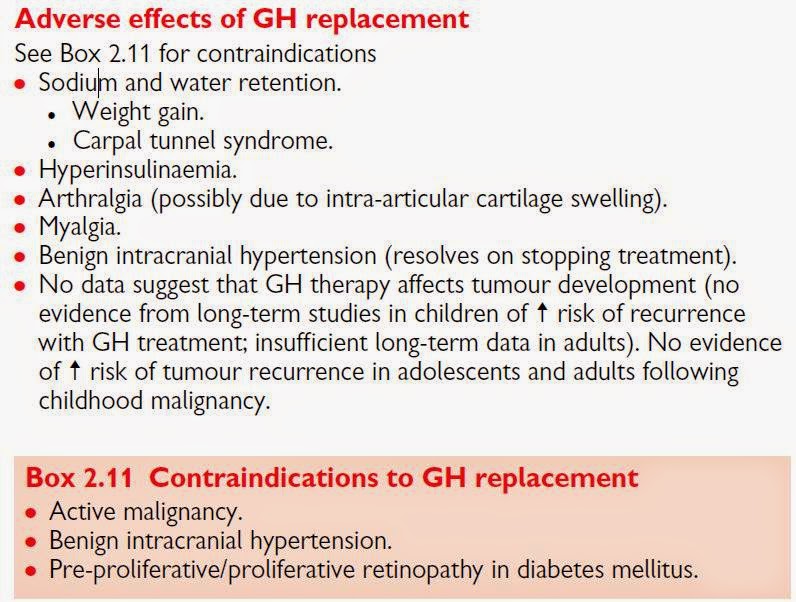
Adverse effects of GH replacement


read more

Pendred syndrome


Pendred syndrome is characterized by both goiter and sensorineural deafness (not caused by hypothyroidism). It is caused by a biallelic mutation in the SLC26A4 gene, located on chromosome 7 (7q31). Pendrin, a multifunctional anion exchanger, functions in both the thyroid gland and inner ear.

In the apical membrane of the thyroid gland, pendrin facilitates transport of iodide into the exocytic vesicles in which thyroid hormone is synthesized.

Pendrin is also expressed in the inner ear and is important for normal endolymph composition and maintenance of the endocochlear potential.
read more

MELAS


MELAS=The syndrome of mitochondrial encephalomyopathy with lactic acidosis and stroke-like episodes

An A-to-G transition in the mitochondrial transfer RNA Leu(UUR) gene at base pair 3243 has been shown to be associated with maternally transmitted diabetes and sensorineural hearing loss. In other subjects, this mutation is associated with diabetes and the syndrome of mitochondrial myopathy, encephalopathy, lactic acidosis, and stroke-like episodes (MELAS syndrome). The mitochondrion plays a key role in the regulation of insulin secretion, particularly in response to glucose.

MELAS is a maternally inherited multisystemic disorder caused by mutations of mitochondrial DNA. The hallmark is the occurrence of stroke-like episodes that result in hemiparesis, hemianopia, or cortical blindness. Other common features include focal or generalized seizures, recurrent migraine-like headaches, vomiting, short stature, hearing loss, and muscle weakness. 80 percent of cases are related to the A3243G mutation and 10 percent to the T3271C transfer RNA mutation.

MELAS usually manifests in childhood after a normal early development [46,47,50]. A relapsing-remitting course is most common, with stroke-like episodes leading to progressive neurologic dysfunction and dementia.

The diagnostic criteria required:
--stroke-like episodes before age 40 years,
--encephalopathy characterized by seizures or dementia,
--either blood lactic acidosis or the presence of ragged red fibers in skeletal muscle biopsy

However, a broader range of phenotypes is now recognized as compatible with the diagnosis, including clinical onset after age 40.
read more

Other Causes of Hypoparathyroidism


Neonatal hypoparathyroidism can be part of the DiGeorge syndrome (dysmorphic facies, cardiac defects, immune deficiency, and hypoparathyroidism) due to a microdeletion (or other genetic abnormalities) on chromosome 22q11.2.

The HDR syndrome (hypoparathyroidism, sensorineural deafness, and renal anomalies) due to mutations in or deletion of an allele of the GATA3 transcription factor; and other rare conditions.
read more

2015年3月5日 星期四

Primary aldosteronism


Oral sodiumloading test
病人接受連續三天共218 mmol之鈉鹽(約合12.8公克氯化鈉)之高鈉飲食18
,在第三天到第四天間收集二十四小時小便測量尿液中的醛固酮、鈉離子及肌酸酐(creatinine)。為確認體內鈉鹽是足夠的,小便中之鈉離子應超過每天200 mmol,而尿液醛固酮超過每天33.3 nmol(約合12 μg)即可診斷

Intravenous saline infusion test
overnight空腹的情況下,兩公升生理食鹽水以超過四小時之流速靜脈輸注於側躺之病人,完成輸注時,抽血檢查病人之血清醛固酮濃度;若血清醛固酮濃度超過10 ng/dL,則可診斷為原發性高醛固酮症;介於5~10 ng/dL則可能為雙側腎上腺增生;而正常人小於5 ng/dL。

Fludrocortisone suppression test
Fludrocortisone acetate每六小時0.1mg共四天,同時照三餐每餐給予氯化鈉鹽片2公克。在第四天抽血檢查病人之血清醛固酮濃度,若高於6 ng/dL則可診斷原發性高醛固酮症。

Captopril test
在採檢血清醛固酮濃度及血清張力素活性前一 ~ 二小時單次口服captopril 25 ~ 50 mg,在正常情形下血清醛固酮濃度受captopril抑制會下降超過30%;但原發性高醛固酮症患者則否,且其血清張力素活性仍持續受到抑制。

Posture change test

病人前一晚維持臥姿睡眠,隔天抽晨血後,持續站姿2~4小時再抽第二次血,比較兩次之血清醛固酮濃度,若第二次高於第一次50%以上則為陽性反應;大部分雙側腎上腺增生呈陽性反應,但醛固酮分泌腺瘤及醣皮質醇可矯正型皮質醛酮症其第二次血清醛固酮濃度不會上升,反而下降或不變,故姿勢變化檢查為陰性。
read more

2011年10月17日 星期一

2011年9月11日 星期日

DKA


症狀:polyuria, polydispia, BW loss, nausea, vomiting, abdominal pain, tarchycardia, dehydration

可以灌水:N/S 500~1000 ml/hr,record I/O

可先給HRI 0.15U/kg,接下來泡100U+100ml N/S run 0.1U/kg/hr的速度,以+/-0.5~1U調整,1小時降血糖50~75,不要超過100,會encephalopathy。
read more